Tuesday, 22 October 2013

Port of Shanghai

The world's busiest port is contested by several ports around the world, as there is as yet no standardised means of evaluating port performance and traffic. 

For the past decade, the distinction has been claimed by both the Port of Rotterdam and the Port of Singapore. The former based its measurement on cargo tonnage handled (total weight of goods loaded and discharged), while the latter ranked in terms of shipping tonnage handled (total volume of ships handled). 

Since 2005, the Port of Shanghai has exceeded both ports to take the title in terms of total cargo tonnage.


The Port of Shanghai, comprises a deep-sea port and a river port.


Tuesday, 10 September 2013

Assimilation and integration

What is the difference between assimilation and integration?

Assimilation means that migrants must adapt as much as possible and adopt the national culture. Requiring them to adopt the majority's language, customs and 'values'. 
Assimilation means absorbing minorities into the ways of the majority. 


Integration mens that migrants take an active part in society.
Integration, by contrast, requires acceptance of a country's laws, of human rights such as freedom of speech, and of basic democratic rights, but does not require the eradication of all cultural differences or group-identities; it is conceived of as a two-way process, through which both the majority and the minorities influence and change one another, and in which differences can be peacefully accommodated as long is there a common commitment to living together.


The word segregation means separation. Segregation is separation of humans into (ethnic) groups in daily life.

Monday, 9 September 2013

Dependency ratio

Dependency ratio is the ratio between those of working age and those of non-working age. 
The dependency ratio tells us how many young people (age group 0 to 19) and older people (age group 66 and older) depend on people of working age (age group 20 to 65). 


The dependency ratio is worked out with this formula:


number of 0 to 19 years-olds + number of people aged 65+
--------------------------------------------------------------------------------- x 100%
                    number of 20 to 65 years-olds


Example: Pakistan
A worked example should make this clearer. Pakistan, which is a developing country, has 41% of its population less than 20, and 4% over 65. This makes 55% (100 - (41+4)) between the ages of 15 and 64.


Dependency ratio of Pakistan

     (41) + (4)
= ---------------- x 100
           55

    45
= ----- x 100
    55


=  81.8


Example: New Zealand
New Zealand, a developed country, has 23% of its population less than 20, and 12% over 65. This makes 65% between 15 and 64.


Dependency ratio of New Zealand

     (23) + (12)
= ---------------- x 100
           65

    35
= ----- x 100
    65


=  53.8


Countries that have a high dependency ratio have more people who are not of working age, and fewer who are working and paying taxes. The higher the number, the more people that need looking after.

Friday, 30 August 2013

Colonisation of the US

European colonisation of the Americas began as early as the 10th century (Vikings, Norse sailors) 

Extensive European colonisation began in 1492, when a Spanish expedition headed by Christopher Columbus sailed west to find a new trade route to the Far East but inadvertently found the Americas. European conquest, large-scale exploration, and colonization soon followed. 

The next map shows the European claims in America in 1750.


When the United States won its independence from Great Britain at the end of the Revolutionary War, the country nearly doubled in size. 


After 1783, the United States gained new land from European countries, neighboring countries (such as Mexico), and Indian tribes. This was done through purchases (paying for it), wars and treaties, and the forced removal of Indian tribes from the lands they had occupied for thousands of years.


The 13 original British colonies became the country's first states, but they were not the same size and shape as they are today. It took more than 176 years — from 1783 to 1959 — for all 50 states to become part of the United States of America.


Tuesday, 13 August 2013

Exogenetic process

The exogenetic processes are the processes that shape the land by forces coming on or above the Earth's surface (exogenetic forces).

For example: 
  • The Moon causes tides in the Earth's oceans and other big bodies of water (as a result of other bodies in space). 
  • Impacts from comets and meteoroids change the surface of the Earth. When they strike the Earth, they create craters which are holes, which can be very big or small, in the ground (as a result of other bodies in space).
  • Radiation from the Sun can cause aurorae, which are lights that can be seen at night near the poles (as a result of other bodies in space).
  • An example of an exogenetic process that is not as a result of bodies in space is erosion. Erosion happens as a result of wind, water, ice, or people, animals, or plants digging in the earth.

Endogenetic process

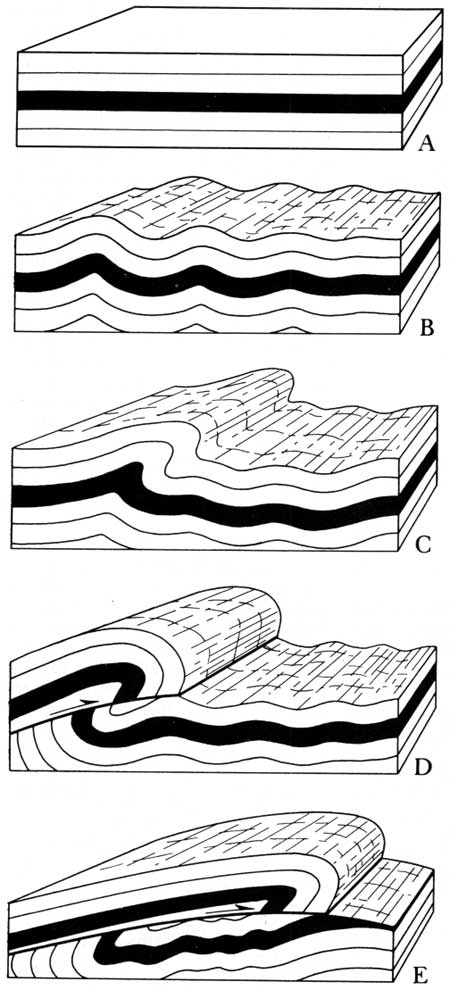
The endogenetic processes are the processes that shape the land by forces coming from within the earth (endogenetic forces). Endogenetic process is also called endogenic process. 

There are 3 main endogenetic processes: 

  • folding, 

  • faulting and 

  • volcanism. 

They take place mainly along the plate boundaries, which are the zones that lay on the edges of plates. These zones are weak. Endogenetic processes cause many major landform features.

Monday, 12 August 2013

The Grand Canyon

The Grand Canyon is a famous, steep-sided canyon carved by the Colorado River in the United States in the state of Arizona. The Grand Canyon is considered one of the Seven Natural Wonders of the World. The Grand Canyon became a national monument in 1908, but wasn't designated as a national park until 1919.


The Grand Canyon is 446 km long, up to 29 km wide and attains a depth of over 1,800 meters.
Nearly two billion years of the Earth's geological history have been exposed as the Colorado River and its tributaries cut their channels through layer after layer of rock while the Colorado Plateau was uplifted by tectonic action.


Evidence suggests the Colorado River established its course through the canyon at least 17 million years ago. Since that time, the Colorado River continued to erode and form the canyon to the point we see it at today.


Many people come from around the world to visit the Grand Canyon. People can also take trips floating on the Colorado River in boats and rafts. Some people like to hike in the Grand Canyon.