Human
migration is the movement by people from one place to another. The
movement is often over long distances and from one country to another, but internal
migration in a country is also possible.
People
may migrate as individuals, in family units or in large groups.

Introduction
Below are four items about human migration:
Below are four items about human migration:
- Human migration.
- Different types of human movements.
- Several categories of migration.
- Reasons for migrating.
Human
migration is the movement of people from one place in the world to another,
2. Different
types of human movements.
Then
tell students that people move for many reasons, and that types of human
migration include:
internal
migration:
|
moving
within a state, country, or continent.
|
external
migration:
|
moving
to a different state, country, or continent.
|
emigration:
|
leaving
one country to move to another.
|
immigration:
|
moving
into a new country.
|
return
migration:
|
moving
back to where you came from.
|
seasonal
migration:
|
moving
with each season or in response to labor or climate conditions.
|
3. Several
categories of migration.
People who
migrate fall into several categories:
An
emigrant
|
is a
person who is leaving one country to live in another.
|
An
immigrant
|
is a
person who is entering a country from another to make a new home.
|
A
refugee
|
is a
person who has moved to a new country because of a problem in their former
home.
|

4. Reasons
for migrating.
Why do
people move? What forces drive human migration?
People
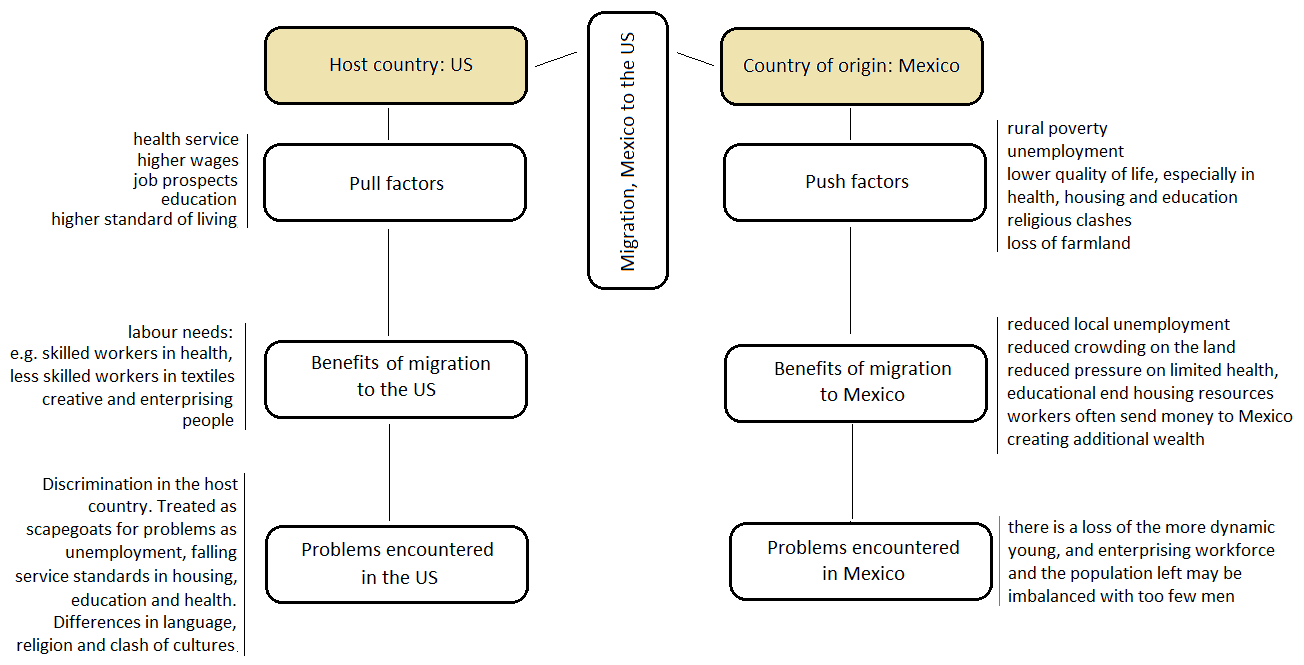
move for many reasons and those reasons are called push factors and pull
factors:
Push factors
|
Tell
students that push factors include leaving a place because of a problem, such
as a food shortage, war, or flood.
|
Pull factors
|
Tell
students that pull factors include moving to a place because of something
good, such as a nicer climate, more job opportunities, or a better food
supply.
|

Extra questions:
What
effect does a region’s economy, climate, politics, and culture have on
migration to and from the area? Additional reasons for
migrating, such as displacement by a natural disaster, lack of natural resources,
the state of an economy and more.