Friday, 30 August 2013

Colonisation of the US

European colonisation of the Americas began as early as the 10th century (Vikings, Norse sailors) 

Extensive European colonisation began in 1492, when a Spanish expedition headed by Christopher Columbus sailed west to find a new trade route to the Far East but inadvertently found the Americas. European conquest, large-scale exploration, and colonization soon followed. 

The next map shows the European claims in America in 1750.


When the United States won its independence from Great Britain at the end of the Revolutionary War, the country nearly doubled in size. 


After 1783, the United States gained new land from European countries, neighboring countries (such as Mexico), and Indian tribes. This was done through purchases (paying for it), wars and treaties, and the forced removal of Indian tribes from the lands they had occupied for thousands of years.


The 13 original British colonies became the country's first states, but they were not the same size and shape as they are today. It took more than 176 years — from 1783 to 1959 — for all 50 states to become part of the United States of America.



Tuesday, 13 August 2013

Exogenetic process

The exogenetic processes are the processes that shape the land by forces coming on or above the Earth's surface (exogenetic forces).

For example: 
  • The Moon causes tides in the Earth's oceans and other big bodies of water (as a result of other bodies in space). 
  • Impacts from comets and meteoroids change the surface of the Earth. When they strike the Earth, they create craters which are holes, which can be very big or small, in the ground (as a result of other bodies in space).
  • Radiation from the Sun can cause aurorae, which are lights that can be seen at night near the poles (as a result of other bodies in space).
  • An example of an exogenetic process that is not as a result of bodies in space is erosion. Erosion happens as a result of wind, water, ice, or people, animals, or plants digging in the earth.

Endogenetic process

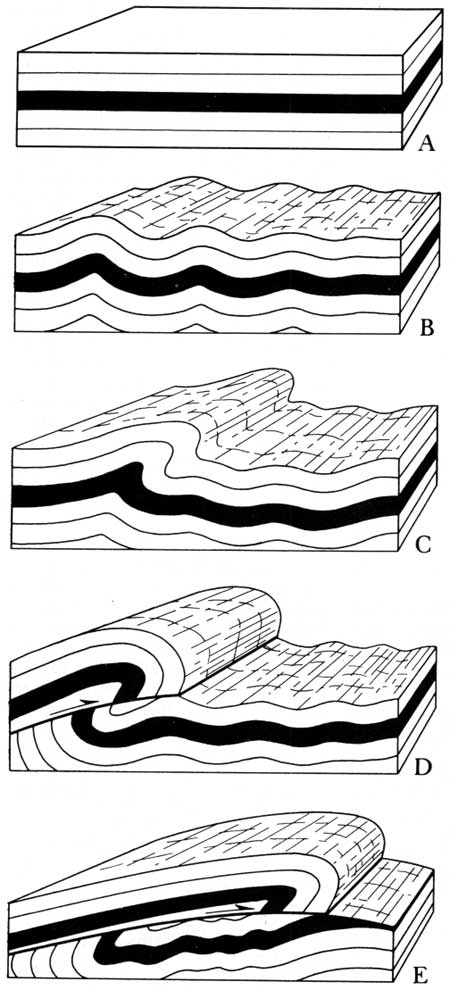
The endogenetic processes are the processes that shape the land by forces coming from within the earth (endogenetic forces). Endogenetic process is also called endogenic process. 

There are 3 main endogenetic processes: 

  • folding, 

  • faulting and 

  • volcanism. 

They take place mainly along the plate boundaries, which are the zones that lay on the edges of plates. These zones are weak. Endogenetic processes cause many major landform features.

Monday, 12 August 2013

The Grand Canyon

The Grand Canyon is a famous, steep-sided canyon carved by the Colorado River in the United States in the state of Arizona. The Grand Canyon is considered one of the Seven Natural Wonders of the World. The Grand Canyon became a national monument in 1908, but wasn't designated as a national park until 1919.


The Grand Canyon is 446 km long, up to 29 km wide and attains a depth of over 1,800 meters.
Nearly two billion years of the Earth's geological history have been exposed as the Colorado River and its tributaries cut their channels through layer after layer of rock while the Colorado Plateau was uplifted by tectonic action.


Evidence suggests the Colorado River established its course through the canyon at least 17 million years ago. Since that time, the Colorado River continued to erode and form the canyon to the point we see it at today.


Many people come from around the world to visit the Grand Canyon. People can also take trips floating on the Colorado River in boats and rafts. Some people like to hike in the Grand Canyon.


Sunday, 7 July 2013

Z - list of geographical terms and definitions

Z
Zenith: The highest point in heaven directly above our heads.
Zeugen: Zeugen, also known as mushroom rocks or rock pedestals, are one of the most striking manifestation of the processes of erosion and weathering. They are mostly found in deserts.
Zonal soil: Zonal soil refers to any one of the great groups of soil which have well-developed soil characteristics and reflect the zonal influence of climate and living organisms, mainly vegetation, as active factors of soil genesis.
Zone in Transition: the inner city area around the CBD. It is a zone of mixed land uses, ranging from car parks and derelict buildings to slums, cafes and older houses, often converted to offices or industrial use.
Zoning: where industry is separated from residential areas to avoid pollution, traffic congestion etc. Zoned areas are a result of planning.
Zooplankton: In geographic terms, a zooplankton refers to the aggregate of animals or animal-like organisms in plankton, as protozoans.


Y - list of geographical terms and definitions

Y
Yardang: In geography, yardang refers to a keel-shaped crest or ridge of rock. It is formed by the action of wind, usually parallel to the prevailing wind direction.
Yield: how many crops a particular field, farm, or area of land produces. It also applies to milk (yields) from dairy cows.
Yield: The term yield has a lot of interpretations in several contexts. However, in geography, the term yield refers to give forth or produce by a natural process or in return for cultivation.
Younger Dryas: In geography, dryas refers to any creeping plant belonging to the genus Dryas, of the rose family, having solitary white or yellow flowers, comprising the mountain avens. Hence a younger dryas refers to a dryas that is younger.
Youthful Population Structure: seen as a wide base on population pyramids that reflect high birth rates in LEDCs.
Youthful Population: in the population structure of LEDCs, there is often a higher proportion of young people due to high birth rates and a reduction in infant mortality due to better nutrition, education and medical care. This may create problems since the children need feeding, housing, education and eventually a job. Medical care and education has to be paid for by taxing a proportionally small number of workers.


X - list of geographical terms and definitions

X
Xerophytic: In geography, xerophytic refers to one which has adapted itself to a xeric (which means dry) environment.
Xerosere: Xerosere refers to describe a sere occurring in dry soil.